24×7 Cab Booking

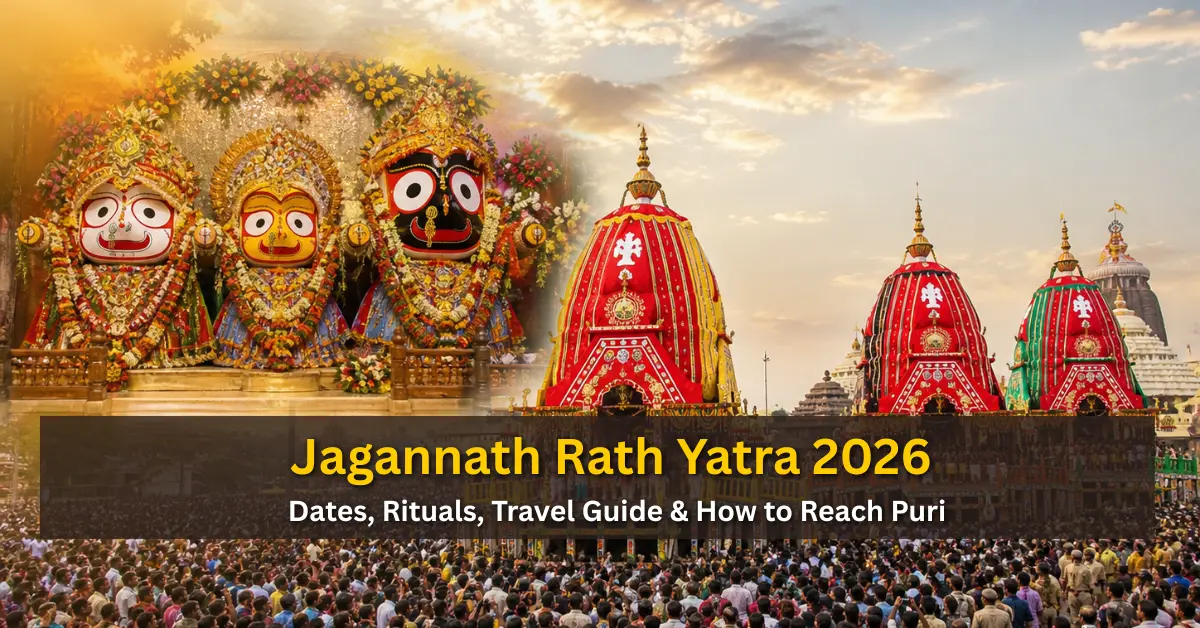
The Jagannath Rath Yatra 2026 falls on Thursday, July 16, 2026. It is one of India's largest religious festivals, where millions of devotees gather on the Grand Road of Puri, Odisha to witness and pull the massive wooden chariots of Lord Jagannath, Lord Balabhadra, and Goddess Subhadra. The return journey (Bahuda Yatra) takes place on Friday, July 24, 2026. If you are planning to attend, this guide covers everything — from the festival schedule and rituals to how to travel to Puri by road, rail, or air.
There are religious festivals in India. And then there is the Jagannath Rath Yatra.
Every year in the coastal city of Puri, Odisha, something extraordinary happens. The idols of Lord Jagannath, Lord Balabhadra, and Goddess Subhadra — who live deep inside the sanctum of the 12th-century Jagannath Temple — step outside their home. They are placed on towering wooden chariots and pulled through the streets by hundreds of thousands of devotees, chanting "Jai Jagannath!"
No temple entry restrictions. No barriers of caste, religion, or nationality. Just the open sky, the sacred road called Bada Danda, and the whole world pulling together.
In 2026, this divine spectacle happens on July 16. And if you are even remotely considering attending it, there is only one piece of advice: start planning now.
The legend says that Lord Jagannath himself wanted to leave the temple and meet his devotees — all of them, not just those permitted inside the sanctum. And so, he set out in his chariot, along with his elder brother Lord Balabhadra and sister Goddess Subhadra, on a journey to visit their maternal aunt's home, the Gundicha Temple, about 3 kilometres away.
This journey is the Jagannath Rath Yatra.
The deities stay at Gundicha Temple for nine days and then return to the main Jagannath Temple in the Bahuda Yatra (return procession). The festival is rooted in equality — even the king of Puri kneels and sweeps the path clean for the Lord's chariot. According to the Skanda Purana, witnessing this yatra and hearing about it grants spiritual merit.
Each deity travels in a distinct, hand-crafted wooden chariot built fresh every year from sacred timber:
Lord Balabhadra's chariot leads the procession, followed by Goddess Subhadra's, and Lord Jagannath's Nandighosha completes the divine convoy — a specific order that follows traditional family hierarchy.
The three ropes used to pull the chariots also have names: Sankhachuda (Jagannath), Basuki (Balabhadra), and Swarnachuda (Subhadra). Devotees believe that touching the rope and helping pull, even briefly, cleanses sins accumulated over lifetimes.
Read About - Jagannath Temple In puri: Complete visitors Guide
About 35 days before the main Rath Yatra, the idols are brought out to the Snana Bedi (bathing platform) and ritually bathed with 108 pots of sacred water mixed with sandalwood and aromatic herbs. This is one of the rare times the public can see the deities up close.
After the bath, the deities are believed to fall ill and rest inside for 15 days. During this period (Anasara), the main shrine is closed to public darshan. The Netrotsav ritual marks the deities' recovery, after which the main temple reopens.
On the day of the Rath Yatra, the Gajapati Maharaja (King of Puri) arrives and sweeps the platform of all three chariots with a golden broom and sprinkles holy water. It is a deeply moving ritual — the king, in humble service to the Lord, just like any other devotee.
The procession begins around 7:00 AM on July 16. The massive chariots can take 6 to 8 hours to complete the 3-kilometre journey to Gundicha Temple. Thousands pull in coordinated effort, marshalled by volunteers.
Four days after the Rath Yatra, Goddess Lakshmi — Lord Jagannath's consort — visits the Gundicha Temple searching for her husband. A playful tradition where her chariot briefly stops outside and then returns.
The deities are adorned with gold ornaments while still seated on the chariots at the Gundicha Temple. Witnessing this is considered deeply auspicious.
The deities return to the Jagannath Temple in a grand reverse procession. On the way, the chariots stop at Mausi Maa Temple for a sweet offering. The festival concludes with the Niladri Bijay on July 28, when the deities officially return to the sanctum.
The entire procession travels along Bada Danda (Grand Road), a 3-kilometre stretch in the heart of Puri.
Viewing spots fill up very quickly. Arrive by 5:00 AM on July 16 to secure a good position along the route.
Most Hindu temples restrict entry to non-Hindus. The Jagannath Temple in Puri does too — only Hindus can enter the main shrine under regular circumstances. But during the Rath Yatra, the deities come outside. There are no restrictions. Anyone — regardless of religion, caste, or nationality — can see the deities, pull the ropes, and receive blessings.
This is the soul of the festival: God coming to his people, not the other way around.
Puri sees massive crowds during Rath Yatra. Hotels and transport get booked weeks in advance. Plan early.
The nearest airport to Puri is Biju Patnaik International Airport, Bhubaneswar — roughly 60 km away. Daily flights connect Bhubaneswar from Delhi, Mumbai, Kolkata, Chennai, Hyderabad, and Bengaluru. From the airport, the easiest way to reach Puri is a cab from Bhubaneswar to Puri.
Puri has its own railway station — Puri Railway Station — well connected to major cities. Direct trains run from Delhi, Kolkata, Mumbai, Chennai, Bhubaneswar, Hyderabad, and more. The station is just 3 km from the Jagannath Temple.
Travelling by road gives you full control — of timing, halts, and convenience. The most common road route to Puri is via NH 316 from Bhubaneswar (61 km, approximately 1.5 hours in normal traffic).
For groups and families, a tempo traveller hire is the smartest choice. You get a comfortable, air-conditioned vehicle for the whole group — no crowded trains, no multiple cab bookings, no luggage struggles.
Whether you are travelling solo, with family, or in a group of 10–25 people, HurryUp Cabs has the right vehicle for your Puri Rath Yatra trip.
Arriving at Bhubaneswar airport or railway station? Book a direct cab service in Puri with HurryUp Cabs for a smooth, no-hassle transfer. Our cabs are available 24/7, with no advance payment required.
One of the most searched routes during Rath Yatra season — Bhubaneswar to Puri cab bookings spike weeks before the festival. Book early to lock in your slot. The drive via NH 316 takes about 1.5 hours under normal conditions (expect longer travel times during peak festival days).
Travelling in a group? A tempo traveller in Puri is the most comfortable and cost-effective way to move. HurryUp Cabs operates a fleet of standard and Maharaja tempo travellers seating 9 to 26 passengers — ideal for family groups, friend groups, office pilgrimages, or package tours.
Why choose HurryUp Cabs for Rath Yatra 2026:
If you are making the trip, extend it into a full Odisha experience:
A tempo traveller hire from Puri covers all these spots in a comfortable 2–3 day circuit.
Non-Hindus are welcome to watch the procession and participate in chariot pulling from the route. Entry to the Jagannath Temple sanctum, however, is restricted to Hindus.
The Jagannath Rath Yatra 2026 on July 16 is not just a festival. It is one of those rare moments where millions of people — different languages, different faiths, different backgrounds — stand on the same road and pull the same rope.
If you are planning to witness it, do not leave your travel to the last minute. Puri during Rath Yatra is one of the most crowded places on earth, and accommodation, transport, and even entry positions on the route get claimed weeks ahead.
Book your cab service in Puri or tempo traveller hire with HurryUp Cabs early. We will get you to the Grand Road comfortably, so all your energy is saved for what really matters — the darshan.
Jai Jagannath!
Read More About
Best time to visit in Puri

 Tirupati to Hyderabad Distance: Travel Time, Routes & Best Way to Travel
September 17, 2026
Tirupati to Hyderabad Distance: Travel Time, Routes & Best Way to Travel
September 17, 2026
 Pune to Aurangabad Distance: Complete Travel Guide & Route Info
September 05, 2026
Pune to Aurangabad Distance: Complete Travel Guide & Route Info
September 05, 2026
 Tirupati to Bangalore Distance: Route & Travel Guide
August 29, 2026
Tirupati to Bangalore Distance: Route & Travel Guide
August 29, 2026
 Coimbatore to Bangalore Distance by Car, Bus & Train – Complete Guide
July 21, 2026
Coimbatore to Bangalore Distance by Car, Bus & Train – Complete Guide
July 21, 2026
 Bangalore to Tirupati Distance: Complete Road Trip Guide
July 15, 2026
Bangalore to Tirupati Distance: Complete Road Trip Guide
July 15, 2026
 Pune to Bhimashankar Distance, Route, How to Reach & Travel Guide
July 07, 2026
Pune to Bhimashankar Distance, Route, How to Reach & Travel Guide
July 07, 2026
 Hyderabad to Tirupati Distance: Route Guide, Travel Time & Best Way to Travel
June 27, 2026
Hyderabad to Tirupati Distance: Route Guide, Travel Time & Best Way to Travel
June 27, 2026
 Jagannath Temple in Puri: Complete Visitor Guide — Darshan Timings, Entry Rules & Tips (2026)
June 16, 2026
Jagannath Temple in Puri: Complete Visitor Guide — Darshan Timings, Entry Rules & Tips (2026)
June 16, 2026
 Best Time to Visit Puri Odisha: Month-by-Month Guide for Every Traveller
June 11, 2026
Best Time to Visit Puri Odisha: Month-by-Month Guide for Every Traveller
June 11, 2026
 Kolkata to Digha Distance: Complete Road Trip & Travel Guide
May 29, 2026
Kolkata to Digha Distance: Complete Road Trip & Travel Guide
May 29, 2026

0 Comments
No comments yet. Be the first to share your thoughts!
Leave a Comment