24×7 Cab Booking

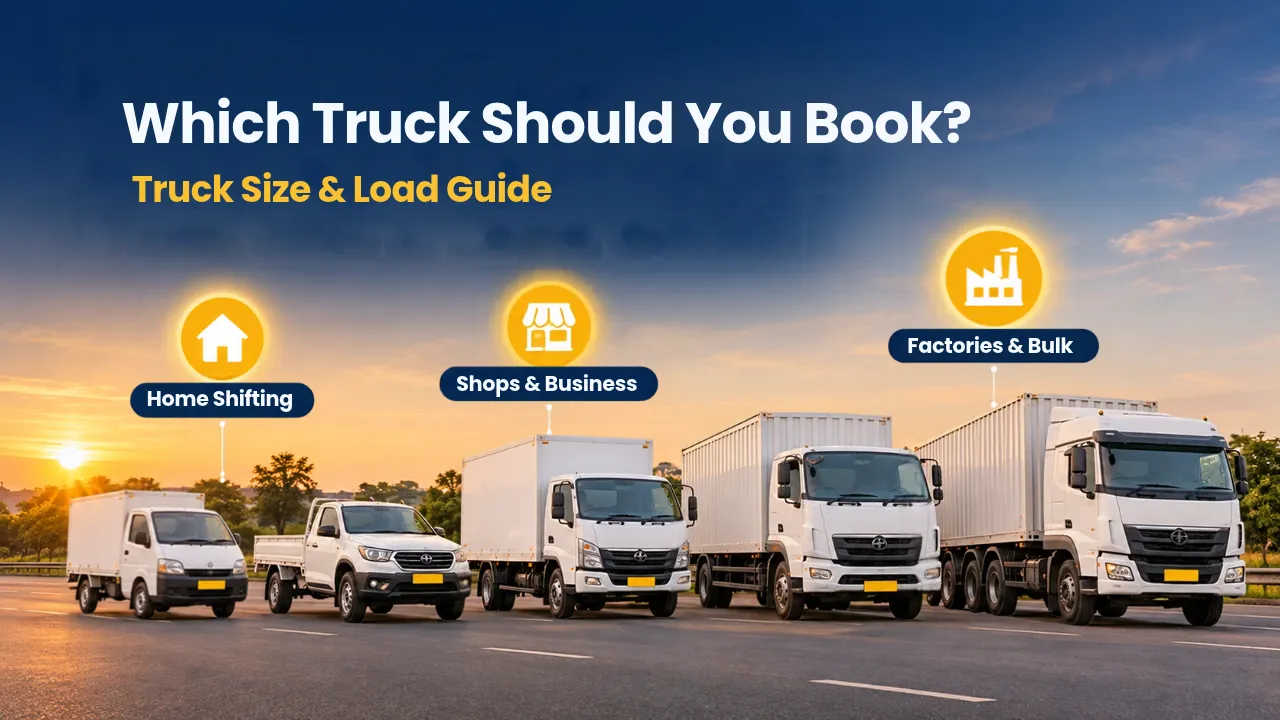
Pick the truck by what you are moving, not by the lowest quote. As a rough guide, a mini truck (the Tata Ace type) suits a few household items or small shop goods, a pickup suits a 1 BHK move or small business loads, a 14 ft truck suits a 2 BHK home or mid-size business loads, a 17 to 20 ft truck suits a 3 BHK home or regular factory dispatch, and 22 ft trucks, containers and trailers suit large industrial loads. Sizes and capacities differ by make and model, so always confirm the exact load with the truck owner before you book.
At a glance
Book a truck that is too big, and you pay for empty space. Book one that is too small, and you end up with a second trip, or a driver who has to refuse because the truck is overloaded.
Most people get stuck because truck listings use words like "14 ft", "4 tonne" and "6 tyre", and it is not obvious what any of them mean for a sofa, a pallet of boxes or a week of shop stock. This guide explains them in plain words, then matches common trucks to common needs: a home move, a shop, a factory or a farm.
Every load has two limits, space and weight, and the one you reach first decides your truck.
Check both. A truck with enough space can still be too weak for your load.
Truck | Typical body length | Rough load | Commonly used for |
| Mini truck (Tata Ace or Chhota Hathi type) | 7 to 8 ft | Up to about 1 tonne | A few household items, small shop goods, local deliveries |
| Pickup (Bolero Pickup or Dost type) | 8 to 10 ft | About 1 to 2 tonnes | 1 BHK shifting, retail stock, farm produce, small business loads |
| 14 ft truck (Eicher type) | 14 ft | About 3.5 to 5 tonnes | 2 BHK homes, mid-size business dispatch |
| 17 to 20 ft truck | 17 to 20 ft | About 5 to 9 tonnes | 3 BHK homes, bulk dispatch, long-distance loads |
| 22 to 24 ft truck (10 or 12 tyre) | 22 to 24 ft | About 10 to 20 tonnes | Large industrial and commercial loads |
| Containers and trailers | 32 ft and above | About 7 to 35 tonnes or more | Bulk goods, machinery, long-haul freight |
These are rough, commonly used ranges. Capacity changes with the make, the model and the body type, so the exact load is always confirmed with the truck owner.
Good for: a few pieces of furniture, a fridge and some boxes, small shop deliveries, and quick local runs in narrow lanes.
Watch out for: it is small. A full 1 BHK home will usually need more than one trip, and long distances with heavy goods are a poor fit.
Good for: a 1 BHK move, retail and wholesale stock, farm produce, and loads that are too big for a mini truck but do not need a full-size truck.
Watch out for: most pickups are open at the back, so cover your goods well, or choose a closed body if the goods are sensitive to rain or dust.
Good for: a 2 BHK home, mid-size business loads, appliances, and regular dispatch from a shop or small unit. It is one of the most booked sizes because it balances space and cost.
Watch out for: narrow lanes and tight turns. Ask whether the truck can reach your door, or whether you need to load at a nearby point.
Good for: a 3 BHK home, larger business loads, and longer routes between cities where you want everything in one trip.
Watch out for: access. A truck this long cannot enter many residential streets.
Good for: large industrial loads, bulk building material in covered bodies, and big commercial consignments.
Watch out for: loading arrangements. These trucks need space, and often a forklift, a ramp or a loading bay.
Good for: bulk goods, machinery, packed consignments that need a sealed body, and long-haul freight between cities.
Watch out for: a container loads from the back only, which makes odd-shaped goods harder to fit. Heavy machinery needs the right trailer and a proper loading plan, so discuss it with the truck owner early.
Size is half the choice. The body type is the other half.
Body type | Best for | Keep in mind |
| Open body | Bulky or tall goods, building material, sacks with a cover | Goods are exposed to rain and dust, so use tarpaulin |
| Closed body | Household goods, electronics, packed goods | Protects from weather and theft, but loading is mostly from the back and sides |
| Container | Valuable or sensitive goods over long distances | Sealed and secure, but awkward for odd shapes |
| Refrigerated (reefer) | Dairy, frozen food, medicines, flowers | Needed whenever temperature matters |
| Tanker | Liquids and gas | Specialised, so confirm what the tanker is approved to carry |
| Flatbed or trailer | Heavy machinery and equipment | Needs a proper loading and tie-down plan |
If you are unsure, ask yourself one question: would this load be damaged by rain, heat or dust? If yes, choose a closed body, container or refrigerated truck.
The right truck depends on your home size, how much furniture you have and how far you are moving. As a rough guide:
Move | Usual truck |
| A single room, a PG or a few items | Mini truck |
| 1 BHK | Pickup, or a mini truck for a light home |
| 2 BHK | 14 ft truck |
| 3 BHK | 17 to 19 ft truck |
| 4 BHK or a large house | 19 to 22 ft truck |
This varies with the amount of furniture you own. Before you choose, count your big items: beds, wardrobes, a fridge, a washing machine, a sofa set. Also note the lanes, the floors and whether there is a lift. If you are right between two sizes, go one size up. A second trip costs more than a bigger truck.
Retail stock, wholesale goods and online sellers usually do well with a mini truck for daily local runs, a pickup for regular loads and a 14 ft truck for weekly bulk movement. Choose a closed body for packed goods that must stay dry, and think about how often you ship, not only about one trip.
Factories move raw material in and finished goods out, so think in pallets and weight. For regular dispatch, a 17 to 20 ft closed body or a container works well. For bulk movement, look at 22 ft trucks, containers and trailers. For goods that need cooling, choose a refrigerated truck, and for liquids, a tanker. For heavy machinery, a flatbed or trailer is the right tool.
Before booking, have these details ready: the number of pallets or cartons, the weight, the size of each pallet and whether loading is by forklift or by hand.
Sacks, produce and cartons move well in a pickup or a 14 ft truck. Open bodies work for sacks in dry weather, as long as you cover them. For produce that spoils, ask about ventilation, and if the trip is long and the weather is hot, a refrigerated truck is worth asking about.
Sand, stone and similar material usually move in tippers. Machinery needs a flatbed or trailer. For equipment rentals, see our construction equipment page.
Overloading a truck is unsafe and illegal. It lengthens braking distance, strains the tyres and engine, can damage your goods and can lead to a fine or a stopped trip. A responsible truck owner will refuse an overloaded trip, and they are right to.
If your load sits close to a truck's limit, do not push it. Book the next size up.
The more accurate your details, the better the match. Share these:
The truck owner will then confirm the right vehicle, the load and the rate with you.
HurryUp lists truck categories from mini trucks and pickups to LCVs, MCVs, heavy trucks, trailers and special vehicles. You can look through them on the fleets page and the transport services page.
The exact vehicle, load, rate and terms are confirmed between you and the truck owner or driver, so tell them your requirement clearly and ask any question before you agree. If you need help, HurryUp support is available on +91 7081123339 and +91 9422799145.
For a step-by-step look at booking, read our guide to online truck booking in India.
Choosing by the quote alone. A lower quote for a truck that is too small becomes more expensive when you need a second trip.
Looking at feet and ignoring weight. A truck with enough space can still be too weak for heavy goods.
Forgetting access. A long truck cannot enter a narrow lane, so ask about the last stretch to your door.
Underestimating the packing volume. Boxes, loose items and bags take more space than people expect. When in doubt, go one size up.
Skipping the cover. An open body without a tarpaulin leaves your goods exposed.
Asking the driver to carry extra. It is not fair on the driver and not safe on the road.
Before you book, answer these:
If your answers sit between two sizes, choose the bigger one.
Have your list of goods, your pickup and drop details and your date ready. Browse the transport services page and the fleets page to see the truck types, or call HurryUp support on +91 7081123339 or +91 9422799145.
Which truck is best for house shifting?
It depends on your home size. A mini truck suits a room or a few items, a pickup suits a 1 BHK, a 14 ft truck suits a 2 BHK, and a 17 to 19 ft truck suits a 3 BHK. Larger homes may need 19 to 22 ft.
What is a mini truck?
A mini truck is a small goods vehicle, commonly known by names such as Tata Ace or Chhota Hathi. It carries up to about one tonne and suits local deliveries and small loads.
How much weight can a 14 ft truck carry?
Roughly 3.5 to 5 tonnes, depending on the make, the model and the body. Confirm the exact capacity with the truck owner.
What is the difference between LCV, MCV and HCV?
Broadly, LCV means light commercial vehicles such as mini trucks, pickups and smaller trucks. MCV means medium vehicles, such as mid-size trucks. HCV means heavy vehicles such as large trucks, containers and trailers. The exact label can vary by vehicle.
Should I choose an open body or a closed body truck?
Choose a closed body if your goods can be damaged by rain, dust or theft, such as household goods and electronics. An open body suits bulky or tall goods and building material, as long as you cover them.
Do I pay for the full truck even if I load only half?
In most full-truck bookings, you pay for the truck and not for the amount loaded. If your load is small, a smaller truck is usually the better choice.
Can I load more than the truck's rated capacity?
No. Overloading is unsafe and illegal, and the truck owner can refuse the trip. Book a bigger truck instead.
Who decides the rate for a truck booking?
The rate, load and terms are agreed between you and the truck owner or driver. Share your requirement clearly so the quote matches your load.
Is loading and unloading help included?
Not always. Ask the truck owner before you book, so you know whether you need to arrange labour.
How do I choose if I am not sure?
Tell the truck owner what you are moving, roughly how much, and any access limits. They can suggest a size. If you are between two sizes, go one size up.

Online Beta | Your ride. Our priority.


0 Comments
No comments yet. Be the first to share your thoughts!
Leave a Comment