24×7 Cab Booking

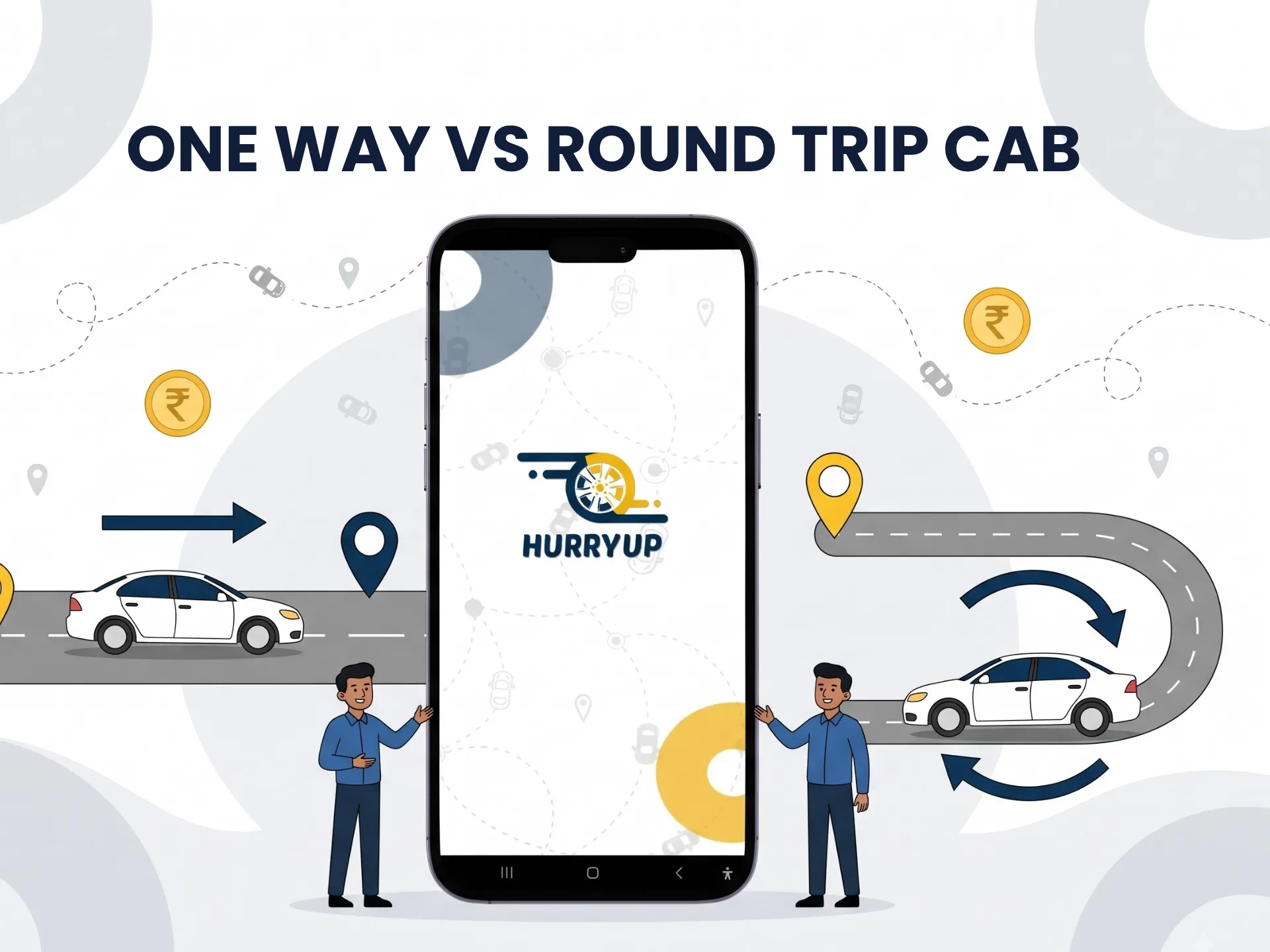
Neither is always cheaper. A one-way cab usually costs less when you only travel in one direction, or when you stay at your destination for several days and do not need a cab there. A round trip usually costs less when you come back the same day or after a short stay, because the same driver waits for you and brings you home.
At a glance
We get this question almost every day: "Should I book one-way or round trip? Which one is cheaper?" The honest reply is that it depends on what you do after you reach your destination.
A lot of websites say "why pay double fare, book one-way". That line is true in one situation only: when you really are travelling in one direction. If you are going to a hill station for a day and coming back the same night, paying for two separate one-way trips can cost you more than a round trip.
So instead of giving you a rule that sounds neat but fails half the time, this guide shows you how the pricing works and how to check it yourself in two minutes.
Here is the whole comparison in one table.
One-way | Round trip | |
| What you pay for | One direction | Both directions, plus the driver staying with you |
| Cab stays with you at the destination | No | Yes |
| Best for | Single-direction trips, long stays, airport and station drops | Same-day or short-stay trips, sightseeing |
| Usual extras to check | Tolls, parking | Driver allowance, night charges, extra days, tolls, parking |
| Flexibility | Fixed route, one leg | Stops and plan changes along the way |
Extras differ by route and vehicle, so always check them in your own quote.
A one-way trip is the simplest kind. You are picked up at one place and dropped at another, and you pay only for that single journey. There is no return fare because you are not coming back with the same cab.
You may notice that the rate per kilometre on a one-way trip can look higher than on a round trip. There is a reason. After dropping you, the driver has to drive back empty or hunt for another passenger in a city that may be far from home. That cost is part of the one-way rate.
Even with that higher rate, your total is lower for a single-direction journey, because you are not paying for the way back. That is why one-way works so well for:
You can see how this works on the HurryUp one-way cabs page.
In a round trip, the same cab and driver take you to your destination and bring you back. The driver stays with you for the whole journey, which means the cab is also available for local travel at the destination.
A round trip fare is usually built from a few parts:
The exact numbers vary by route and vehicle. The point to remember is that you are paying for the driver's time as well as the distance. A longer stay means a bigger bill, even if the cab sits idle for part of it.
Round trips make sense for weekend getaways, business visits and family sightseeing, where you want one driver and one car for the entire plan. If you are weighing options for a longer outstation plan, our outstation cab page lists the routes and vehicles you can choose from.
Here is how it usually works out. Treat these as a guide, then check them against your quotes.
You go and return the same day. A round trip usually wins. The driver waits, you travel back with the same cab, and you avoid booking two separate trips.
You stay one or two nights and want a cab for local sightseeing. A round trip usually wins. You get a driver who knows the area, and you do not have to arrange local transport.
You stay four or more days and will not use a cab at the destination. Two one-way bookings can win. With a round trip, you may end up paying for days the cab is not working for you.
You go to one city and come back from another. One-way for each leg is the natural fit. A round trip does not suit a route that does not return to its start.
You move between several places on a pilgrimage or a long tour. One-way for each leg often works better, because your plan keeps changing and you can match each leg to the right driver and car.
You need an airport or railway station transfer. One-way, almost always.
The rule behind all of these: compare the round trip total with the total of two one-way fares for the same dates. Whichever total is smaller is your answer.
Most guides compare only two choices. HurryUp Cabs has a third one that can change the math.
When a driver drops a passenger at a destination, they usually have to drive back without anyone in the car. On HurryUp, drivers who have just made a drop can update their availability for a return booking. If you want to travel in that direction on that day, you can book that driver for your journey.
For the driver, that is a paid return instead of an empty drive. For you, it can mean a better fare for the same trip.
A return booking suits you if:
It may not suit you if you have a fixed pickup time, such as a morning flight. In that case, a normal one-way booking is safer.
You can look at available options on the return booking page.
HurryUp gives you two ways to book, and each helps with this decision in a different way. If you want the full detail, read our guide on how HurryUp Cabs works: enquiry vs full booking. Here is the short version for this topic.
With an enquiry, you send your trip details, pay no advance, and up to two local drivers contact you with their rates. This is a good moment to ask each driver the same question twice: "What is your price for a round trip with this stay, and what is your price for a one-way each way?" You then compare both answers from both drivers.
With a full booking, you see the average fare, choose your vehicle and pay a 7% advance to confirm. You can offer your own rate within a limit, and drivers can counter-offer. Use it when your dates are fixed and you want certainty.
Either way, give the driver your real plan, including how many nights you will stay and whether you want a cab at the destination. A quote based on the wrong plan helps nobody.
A lower number on the screen is not always a cheaper trip. Before you decide, ask whether these are included:
The easiest habit: ask the driver, "Is this the total I will pay, or are there extras?" and ask for the answer in a message.
Booking a round trip when you only need one direction. If you are coming back by train, you do not need a driver waiting for you.
Hiding the real stay length. If you tell a driver "two days" and then stay four, the price will change.
Comparing quotes that include different things. A fare with tolls and a fare without them are not the same fare.
Booking two one-ways in peak season without a plan. On wedding days, festivals and long weekends, finding a driver at the destination can be hard. Confirm the second booking early.
Ignoring extra kilometres. On hill routes and sightseeing days, you can cover far more distance than your route suggests, and a distance-based fare grows with it.
Answer these, and you will know what to book:
If your answers are "one night or less, same place, yes, fixed, yes", lean towards a round trip. If they are "several nights, different place, no, flexible, yes", lean towards one-way or a return booking.
Ready to compare?
Tell us your route, dates and stay length, and compare what drivers offer. Send an enquiry or book now, or look at one-way cabs, return booking and outstation cabs. Questions? Call +91 7081123339 or +91 9422799145, or visit the contact page.

Online Beta | Your ride. Our priority.


0 Comments
No comments yet. Be the first to share your thoughts!
Leave a Comment