24×7 Cab Booking

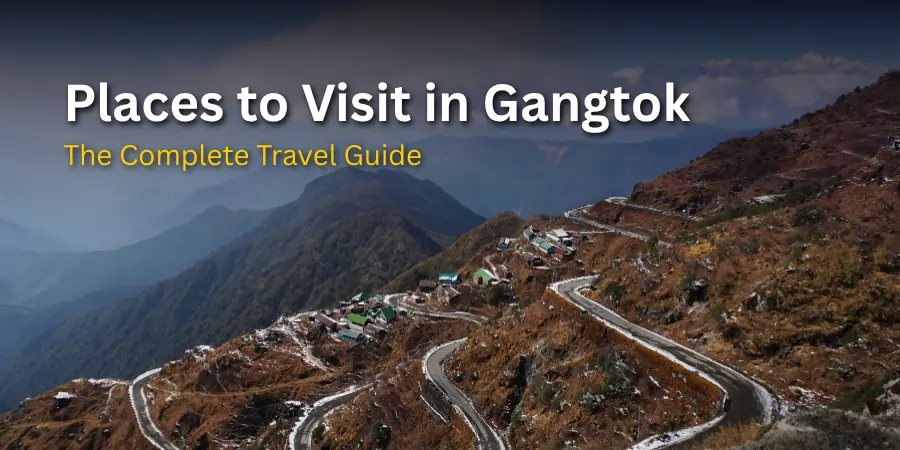
Gangtok is one of those rare cities that stays with you long after you've left. Sitting at 1,650 metres in the eastern Himalayas, the capital of Sikkim blends Tibetan Buddhist culture with a surprisingly modern, stylish urban energy. Colourful prayer flags flutter across every corner. Snow-capped peaks reveal themselves between clouds. And come evening, MG Marg transforms into one of the most lively pedestrian streets in all of Northeast India.
Whether you're a first-timer or returning for more, the places to visit in Gangtok have something for every kind of traveller — from spiritual seekers and nature lovers to adventure enthusiasts and shoppers. This guide covers all the major Gangtok tourist attractions, the best season to visit, how to reach the city, and everything you need to plan a smooth trip.
Knowing the right time to visit makes a massive difference to your experience.
March to May (Spring — Best for scenic beauty) This is arguably the finest time to visit Gangtok. Rhododendrons bloom across the hillsides, skies are relatively clear, and the temperatures are comfortable — ranging between 10°C and 20°C. Visibility is excellent, making mountain views from spots like Tashi Viewpoint truly spectacular. If you're planning a trip to Tsomgo Lake or Nathu La Pass, spring is ideal.
June to September (Monsoon — For green landscapes, fewer crowds) Gangtok receives heavy rainfall during monsoon, but it doesn't stop functioning. The city stays lush, waterfalls like Bakthang are at their most dramatic, and tourist crowds thin out considerably. However, road conditions can be unpredictable, especially on the route to North Sikkim. Plan with some flexibility.
October to December (Autumn-Winter — Best for clear mountain views) October and November bring clear skies, dry weather, and some of the best panoramic views of Kanchenjunga you'll ever see. December marks the beginning of snowfall season, and the city takes on a magical, quiet quality. If you're wondering about the best season to visit Darjeeling and Gangtok together, October–November works perfectly for both.
January to February (Winter — For snow, fewer tourists) Winter is cold, often dropping to near 0°C. But for travellers who want to experience snowfall, this is the season. Tsomgo Lake freezes over, and the route to Nathu La is blanketed in snow. Not ideal for first-timers, but unforgettable for the adventurous.
No guide on Gangtok tourist places is complete without MG Marg. This pedestrian-only boulevard stretching about half a kilometre through the heart of the city is where Gangtok truly comes alive. Victorian-style lamp posts, flower beds, a statue of Mahatma Gandhi, cafes serving momos and thukpa, shops selling Sikkimese handicrafts, thangka paintings, woollen shawls — it's all here.
Evenings on MG Marg are especially vibrant. Locals and tourists mix freely, restaurants are packed, and the whole strip has an almost European charm. It's also one of the cleanest public spaces you'll find in any Indian hill station — Gangtok takes its no-littering, no-smoking, no-honking ethos seriously.
Come here for an evening stroll, shopping, street food, and the general pulse of the city.
Timings: Open all day; best in evenings | Entry: Free
Located 8 km from the city centre, Tashi Viewpoint is one of the most popular Gangtok tour spots for obvious reasons. On a clear morning, you get unobstructed views of Mount Kanchenjunga (the world's third highest peak) and Mount Siniolchu — the kind of view that makes you forget to blink.
The viewpoint was built during the reign of King Tashi Namgyal and has been a favourite Gangtok sightseeing stop ever since. Sunrise visits are highly recommended. Carry a jacket — it gets cold up there even in summer.
Best Time to Visit: Early morning, October–April | Distance from City: 8 km
This striking white stupa is one of the most important Buddhist monuments in Sikkim. Built in 1945 by the Nyingmapa order of Tibetan Buddhism, the Do-Drul Chorten is surrounded by 108 prayer wheels that devotees spin as they circumambulate the stupa. The circular walk around the chorten is peaceful and meditative.
Inside the stupa are rare sacred relics, Mandala sets, and Buddhist deity idols. Two large statues of Guru Padmasambhava flank the stupa. It's a short walk from the Namgyal Institute of Tibetology, and the two are best visited together.
Timings: 6 AM – 7 PM | Entry: Free
If you want to understand Sikkimese and Tibetan Buddhist heritage beyond the visual, this institute is one of the most intellectually rewarding attractions in Gangtok. Established in 1958, it houses an exceptional collection of rare manuscripts, thangka paintings, Buddhist religious texts, and ritual objects.
The institute's library is one of the most comprehensive repositories of Tibetan literature outside Tibet. Even a short visit here gives you a much deeper context for everything else you'll see in Gangtok.
Timings: 10 AM – 4 PM (Closed Sundays) | Entry: Nominal fee
Spread across 205 hectares at an elevation of 1,780 metres, the Himalayan Zoological Park is home to some of the rarest animals found in the eastern Himalayas. Red Pandas, Snow Leopards, Himalayan Black Bears, Musk Deer, Barking Deer, and Goral are among the animals housed here.
What makes this zoo distinctive is how the enclosures mimic the animals' natural habitat — dense vegetation, elevation changes, and open spaces. There's a watchtower near the top that offers panoramic views of Kanchenjunga on clear days. Best visited alongside Ganesh Tok, which is located just across.
Timings: 9 AM – 4 PM (Closed Tuesdays) | Entry: Paid
Two small but scenic temples perched at elevated points in Gangtok. Ganesh Tok sits at around 6,500 feet and offers excellent views of the surrounding hills and city. Hanuman Tok, at a slightly higher altitude, has a military touch — the Indian Army maintains a beautiful garden here. Both are calm, quick visits that reward you with one of the better vantage points for Gangtok sightseeing.
Established in 1957, this government centre is where you can watch artisans at work and buy authentic Sikkimese handicrafts — hand-woven carpets, Thangka paintings, bamboo crafts, carved wooden items, embroidered garments, and much more. If you want to bring home something genuinely local and traditionally made, this is the place over any random tourist shop.
Timings: 9 AM – 4 PM (Closed Sundays) | Entry: Free
Located about 3 km from the main town on the way to Tashi Viewpoint, Bakthang Falls is one of those spots many travellers miss — and that's exactly why it feels special. The wide waterfall cascades down a lush green hillside and is at its most powerful during and just after monsoon. There's even a rope-sliding activity here if you want a quick dose of adventure.
Best Season: July–October (post-monsoon for maximum flow)
Some of the finest places to visit in Sikkim Gangtok are actually in the areas surrounding the city — reachable as day trips with a cab.
At an altitude of 3,753 metres, Tsomgo Lake is one of the most visited places near Gangtok and arguably the most iconic. The glacial lake changes colour through the seasons — deep blue in summer, frozen in winter — surrounded by mountains and rhododendron forest. Yak rides are available for a fun photo opportunity.
A Protected Area Permit (PAP) is required for Indian nationals to visit Tsomgo. Foreign nationals need a special Inner Line Permit. Both can be arranged through your travel agent or hotel. Most Gangtok local sightseeing packages include Tsomgo as a standard day trip.
Distance from Gangtok: 40 km | Altitude: 3,753 m | Permit Required: Yes
One of the most thrilling things to do in Gangtok is to visit Nathu La Pass, the historic mountain pass on the Silk Road at 4,310 metres. You literally stand at the border between India and China, with Indian and Chinese soldiers stationed on either side. The views of the surrounding Himalayan landscape are extraordinary.
Note that Nathu La is only open to Indian nationals (foreign nationals are not permitted). A separate permit is required, and the pass is generally closed on Mondays and Tuesdays. Combine with Tsomgo Lake for a full day out.
Distance from Gangtok: 54 km | Altitude: 4,310 m | Open to: Indian nationals only
About 24 km from Gangtok, Rumtek Monastery is the largest monastery in Sikkim and one of the most significant Kagyu order Buddhist monasteries in the world. The complex houses a monastery, shrines, a shedra (monastic college), and sacred relics. The golden chorten in the shrine room is particularly revered.
The drive to Rumtek offers beautiful valley views. The monastery is serene, architecturally stunning, and gives you a different flavour of Buddhist practice compared to the city-based monasteries in Gangtok.
Distance from Gangtok: 24 km | Timings: 6 AM – 6 PM
Right within the city, Enchey Monastery is Gangtok's oldest, built in 1840 by King Sidkeong Namgyal. It's a working Tibetan Buddhist monastery belonging to the Nyingma order. The main prayer hall is colourful and atmospheric. Every year in January, the Chaam Dance — a masked religious dance festival — is performed here and is one of the most visually striking events in Gangtok's calendar.
About 65 km from Gangtok, Ravangla is a quiet hill town in South Sikkim that rewards those who venture beyond the city. The 130-foot Buddha statue at Tathagata Tsal (Buddha Park) is the centrepiece — serene, massive, and set against a backdrop of forest and Himalayan peaks. Ravangla also offers views of Kanchenjunga, Pandim, and other peaks that rival anything you'll see in Gangtok. A perfect half-day or full-day trip.
About 8 km from Gangtok, this well-maintained park is built around a beautiful natural waterfall. It's a good spot for families, with a children's park, garden areas, and a folklore centre featuring life-size models of the legendary Banjhakri shaman figure from Sikkimese mythology. The waterfall itself is picturesque, especially in the wet months.
Timings: 8 AM – 5 PM | Entry: Nominal fee
White Water Rafting on Teesta River: The stretch between Makha and Sirwani is one of the best river rafting spots in Northeast India. Rapids of Grade III and IV make it a serious adventure. Available from October to May.
Cable Car Ride: Gangtok's ropeway connects Deorali to Tashiling via Nam Nang and offers aerial views of the city and surrounding hills. Short, affordable, and a fun way to see the city from above.
Try Sikkimese Cuisine: Momos (steamed dumplings), Thukpa (noodle soup), Gundruk (fermented leaves), Sha Phaley (meat-stuffed bread), and the local Chhang (millet beer) — Gangtok's food scene is reason enough to visit. The restaurants and street stalls around MG Marg are a great starting point.
Shop at New Market: Just off MG Marg, New Market has clothing, electronics, souvenirs, and local snacks. The China Bazaar adds a cross-border goods flavour to the whole experience.
Attend a Monastery Festival: If your visit aligns with Losar (Tibetan New Year), Dussehra, or the Chaam Dance festival at Enchey Monastery, try to be there. These events bring the city's Buddhist culture to life in vivid colour.
The nearest airport is Bagdogra Airport (IXB) in West Bengal, about 124 km from Gangtok. From there, the journey takes approximately 3.5 to 4.5 hours by road depending on traffic and route conditions. Direct flights to Bagdogra operate from Delhi, Kolkata, Mumbai, and Bengaluru.
Pakyong Airport, located just 30 km from Gangtok, is the nearest airport in Sikkim — but flight availability can be limited and weather-dependent. Check before planning around it.
The nearest major railway station is New Jalpaiguri (NJP), well-connected to major Indian cities. From NJP, the road distance to Gangtok is approximately 124 km, taking around 4 hours.
Booking a taxi from New Jalpaiguri to Gangtok is the most popular and convenient option. Shared jeeps and shared taxis are available at the station itself, but for comfort, flexibility, and luggage space — especially if you're travelling in a group or with family — a private cab is the better choice.
Gangtok and Darjeeling are often combined in a single itinerary, and for good reason. The two hill stations are around 95–100 km apart by road and are connected through a scenic mountain route via Sevoke Road and the Teesta River valley. The drive takes roughly 3.5 to 4 hours.
A taxi from Darjeeling to Gangtok is the most practical option — shared cabs operate from Darjeeling's taxi stand, while private cabs give you more flexibility with stops along the way (the Teesta viewpoints mid-route are worth it).
Once in Gangtok, most of the city's own attractions — MG Marg, Do-Drul Chorten, Namgyal Institute, Enchey Monastery — are accessible by local shared cabs or on foot. For day trips to Tsomgo Lake, Nathu La, Rumtek, and Ravangla, you'll need to book a dedicated Gangtok local sightseeing cab for the day. Hotels and travel agents in the city can help with permits and cab bookings.
3 Days: Cover the city's core — MG Marg, Do-Drul Chorten, Namgyal Institute, Enchey Monastery, Himalayan Zoological Park, and a day trip to Tsomgo Lake + Nathu La Pass.
5 Days: Add Rumtek Monastery, Banjhakri Falls, Tashi Viewpoint at sunrise, Teesta rafting, and a day trip to Ravangla.
7+ Days: Extend to North Sikkim (Lachung, Yumthang Valley) or West Sikkim (Yuksom, Khecheopalri Lake). These require additional permits and are best arranged through local travel agents.
Gangtok is one of those destinations that rewards travellers who come prepared — right season, right itinerary, and the right way to get there. Whether you're driving up from the plains, arriving at NJP by train, or combining it with a Darjeeling trip, the journey to Gangtok is as beautiful as the destination itself.
When it comes to getting to Gangtok hassle-free — whether you need a taxi from New Jalpaiguri to Gangtok, a comfortable taxi from Darjeeling to Gangtok, or a dedicated cab for Gangtok local sightseeing — HurryUp Cabs makes the journey smooth, reliable, and comfortable so you can focus entirely on the experience. Book your ride and make Gangtok your next unforgettable trip.

 Tirupati to Hyderabad Distance: Travel Time, Routes & Best Way to Travel
September 17, 2026
Tirupati to Hyderabad Distance: Travel Time, Routes & Best Way to Travel
September 17, 2026
 Pune to Aurangabad Distance: Complete Travel Guide & Route Info
September 05, 2026
Pune to Aurangabad Distance: Complete Travel Guide & Route Info
September 05, 2026
 Tirupati to Bangalore Distance: Route & Travel Guide
August 29, 2026
Tirupati to Bangalore Distance: Route & Travel Guide
August 29, 2026
 Coimbatore to Bangalore Distance by Car, Bus & Train – Complete Guide
July 21, 2026
Coimbatore to Bangalore Distance by Car, Bus & Train – Complete Guide
July 21, 2026
 Bangalore to Tirupati Distance: Complete Road Trip Guide
July 15, 2026
Bangalore to Tirupati Distance: Complete Road Trip Guide
July 15, 2026
 Pune to Bhimashankar Distance, Route, How to Reach & Travel Guide
July 07, 2026
Pune to Bhimashankar Distance, Route, How to Reach & Travel Guide
July 07, 2026
 Hyderabad to Tirupati Distance: Route Guide, Travel Time & Best Way to Travel
June 27, 2026
Hyderabad to Tirupati Distance: Route Guide, Travel Time & Best Way to Travel
June 27, 2026
 Jagannath Temple in Puri: Complete Visitor Guide — Darshan Timings, Entry Rules & Tips (2026)
June 16, 2026
Jagannath Temple in Puri: Complete Visitor Guide — Darshan Timings, Entry Rules & Tips (2026)
June 16, 2026
 Best Time to Visit Puri Odisha: Month-by-Month Guide for Every Traveller
June 11, 2026
Best Time to Visit Puri Odisha: Month-by-Month Guide for Every Traveller
June 11, 2026
 Kolkata to Digha Distance: Complete Road Trip & Travel Guide
May 29, 2026
Kolkata to Digha Distance: Complete Road Trip & Travel Guide
May 29, 2026

0 Comments
No comments yet. Be the first to share your thoughts!
Leave a Comment